Data Center Site: How Deep Can You Go? Efforts to retrofit subterranean bunkers into functional data center space have been underway for years. But as power requirements and security considerations have intensified, selecting underground sites that are specifically designed from day one to house mission critical infrastructure is a new trend.
Ultra-secure underground data center space is being fueled by projected energy, security and regulatory benefits relative to above ground alternatives.
Showing posts with label Data Center Site Selection. Show all posts
Showing posts with label Data Center Site Selection. Show all posts
Friday, March 21, 2014
Some things to consider when running a data center
As businesses go increasingly digital, the need for data centers to
secure company information is more important than ever before. It is not
only tech giants like Google and Facebook that need a place to house
their information - businesses across the healthcare, government and
industrial sectors are looking to data centers as a solution to their
storage needs. But running a data center is not something that can be
done impulsively. Whether your company has the funds and scale of
operations to occupy its own center or ends up looking into existing
facilities, here are some important considerations to keep in mind to
maximize an enterprise data center operation.
Consider renewable energy solutions
In Hollywood movies, data centers are generally represented as massive,
noise-intensive operations that actively drain energy out of whatever
area they are occupying. This public perception of such facilities is
understandable given that data centers must rely on a constant supply of
energy - after all, their functionality depends on remaining active at
all times. But just because they harness energy sources does not mean
data centers can't function in an environmentally-minded, sustainable
way.
Just ask Google, a company that has been dealing with data
storage needs ever since it rented its first data storage facility - a
closet-sized, 7 foot by 4 foot operation
with a mere 30 computers - in 1998, according to CNET. Google has come a
long way since then, and so has its dedication to sustainable methods
of data center operation. The tech giant now has a vast network of data
centers spanning the globe.
What unites Google's facilities is a singular commitment to renewable energy.
With renewable energy currently powering more than a third of Google's
data storage facilities, the company is always looking for ways to
expand the use of solar and wind power,
according to its site. Because it is challenging to have a renewable
power generator on location, the company did the next best thing: It
reached out to renewable energy providers in the area - such as wind
farms - and made deals to buy energy from them. Among Google's energy
suppliers are wind farms in Sweden and Oklahoma.
Through these sources, the company is not only able to maintain solid
data room cooling practices, but benefit the local community.
Have good outside air cooling
When it comes to maintaining an optimal data room temperature, it's best
to follow the lead of companies well-versed in data storage. Google and
Microsoft are two such businesses, and they both share a commitment to
harnessing natural resources to keep their data centers cool.
In
Dublin, Microsoft has invested more than $800 million to date in order
to build a data center that covers almost 600,000 square feet. The
enormous size of the facility would seem to present a major cooling
challenge, but the company has been able to surmount that by using fresh air cooling,
Data Center Knowledge reported. By building the center in Ireland,
where the temperature remains optimal for data room cooling, Microsoft
is able to maximize the location as a natural cooling solution - a move
that saves significant energy costs while keeping the company
environmentally friendly as well. And its commitment to environmentally
sound solutions does not end with cooling: the center also recycles 99
percent of the waste it produces.
Google has a similarly cooling-minded approach with its data facility in Finland, which it hopes will be almost completely powered by
wind energy by 2015, according to Data Center Knowledge. The wind
energy will come from a wind park located nearby. But the center is not
waiting until then to implement good temperature practice. Instead of
relying on chillers and other machine-based cooling techniques, Google
relies on seawater from a nearby Gulf to cool the facility. Its efforts in Finland are part of a broader effort to expand the Google sphere of influence.
"The
Google data center in Hamina offers Eastern Finland a tremendous
opportunity to jump from the industrial to digital age," said Will
Cardwell, a professor at a nearby university.
But just as important as what goes on inside a center is the
environment around it. That is because data centers are invariably
affected by the physical location in which they are located. With that
in mind, here are some more things to look into in order to maximize
your data center potential.
Choose the location wisely
Considering that data centers are necessarily connected to the physical
environment they inhabit, it is important to pinpoint the best location
possible. Data centers are always going to require top-notch
capabilities to maintain a good server room temperature, but the ease
with which that happens can depend on the location of the center. As
always, Google is at the top of the game with regard to location
selection. Its Hamina, Finland center is strategically placed near the Gulf of Finland, enabling an easy and natural data room cooling solution.
But Google is not the only company maximizing natural environments for data center growth. Iron Mountain specializes in underground data center
solutions, according to Data Center Knowledge. Formerly a storage
company for physical records, Iron Mountain already had a 145-acre
underground storage facility in a former limestone mine before it got
into the data center business. This location turned out to be perfect
for data center needs. Blocked from the sunlight and other external heat
sources, the underground facility stays at about 52 degrees without any
kind of additional cooling function. An underground lake provides
further protection against ever needing to bring in a machine cooling
system. The company's so-called "data bunker" gained so much popularity
that Iron Mountain decided to expand its sphere of operations.
Give back to the community the center is in
Data centers often require a big fleet of staff to operate. Fortunately,
they're usually built near communities from which workers can be hired.
But as much as data centers plan to benefit from the community they
inhabit, it is just as important to look for ways to give back. This
kind of behavior encourages connectedness with the community and
improves the reputation of the center - and therefore the company - in
the public eye.
Google paid special attention to the local
community as it developed its Hamina center. When they began mapping out
the concept for the center, Google realized that construction would
take about 18 months. And so they turned to the locals for help. In the
process, they provided steady employment for 800 workers
in the engineering and construction sectors, according to Data Center
Knowledge. Google's willingness to involve locals in the construction
process helped forge a lasting bond between the tech giant and the city.
This bond did not go unnoticed.
"Google's investment decision is important for us and we welcome it warmly," Finnish president Jyrki Katainen said.
And for those who work at the center, life is good.
"No
two days are the same as we change our roles around frequently to keep
things fresh and new," said Julian Cooper, a hardware operations worker at the facility.
Be prepared to surmount environmental obstacles
In the event of a disaster like a hurricane or earthquake, it is vitally
important for all enterprises - especially data centers - to make sure
their stock is safe. Iron Mountain understands the principle of
environmental preparadness quite well, which is why they offer
underground data storage solutions. By storing data underground, Iron
Mountain protects it against any conceivable natural disaster. This
nature-prove construction is especially important for companies like
Marriott, which chose to house data at the Iron Mountain bunker because
of the sense of complete security it afforded.
"We have always had
a rigorous and constant focus on having disaster preparedness in
place," said Marriott operational vice president Dan Blanchard. "Today
we have a data center that provides Marriott with a tremendous
capability for disaster recovery, and we have a great partner in Iron
Mountain."
According to tech journalist David Geer, earthquakes pose a huge threat to data centers in
many areas around the world, since they can be difficult to predict and
potentially cause large-scale damage. If a company intends to build its
facility in an area susceptible to earthquakes, it should apply the
most stringent safeguards, including building a center that is capable
of withstanding a quake one degree higher than the requirement for the
zone it occupies.
Green Mountain Data Center
Located inside the mountain in a former NATO ammunition depot (the largest in northern Europe)
Built for the highest military security level. Secured against electromagnetic pulses (EMP)
"Nuclear secure" facility, secured against sabotage and direct attack from the sea.
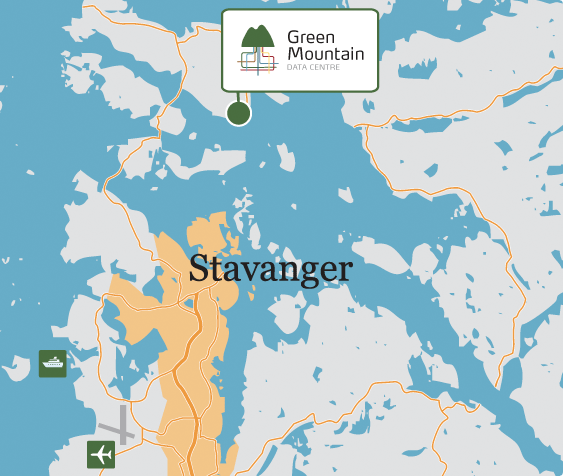
Green Mountain Data Center Green Mountain Data Center a prime piece of real estate tucked inside a scenic Norwegian mountain. Built next to a cool water fjord and surrounded by evergreens and lush rock-clinging mosses, the space boasts of bright, airy subterranean halls carved out of natural cave walls and almost transcendental settings above ground. This will be the comfortable new home for many of Norway’s data servers. The Green Mountain Data Center is one of the first pioneering data centers that will greatly reduce its costs by harnessing the cooling power of the environment, namely, the steady flow of cool water from an adjacent fjord. Alas, the grass seems to be consistently always greener in Scandinavia.
The Green Mountain Data Center contains nine ‘Mountain Halls’—each spanning well over 1,000-square-meters of space to host rows and rows of servers—a workshop, and an administration building. Its servers will be hooked up to an uninterrupted supply of power from a total of eight independent generators as well as three supply lines connected to the central Norwegian network, and its carbon footprint has been thoroughly eliminated.
Of course its most compelling feature, aside from its generally pleasant, Hobbit-like atmosphere noted by Gizmodo, is the cooling system, which relies on the nearby Rennesøy fjord to provide an abundance of cold water year round to cool its resident motherboards. Facebook has gone a similar route by planting a server farm in the Arctic, but we wouldn’t be hard pressed to say that we like the hospitable environment of this data farm better, and it’s nice to see yet another Scandinavian mountain bunker to add to our favorites!
The Mountain Hall
Approx. 21,500 m2 floor space in the mountain
The areas consists of:
– 6 mountain halls each of 1,855 m2
(11 x 164 m each) in size
– 2 mountain halls of 1,546 m2 (19 x 82 m each) in size
- 1 Mountain hall with internal structure 1,370 m2 in size
- I.e. combined mountain halls of 15,692 m2
- Warehouse/workshop 520 m2
- Administration building 840 m2
- Quay w/"roll on-roll off" option
Fire safety and fire
protection
Closed caverns enable the use
of inert / hypoxic air ventilation
Reduced oxygen level to prevent fire and smoke
- 02 reduced to 15 -16 %
- Fire cannot arise as the combustion process
does not get enough oxygen
- Corresponds to an altitude of approx. 3,000 m
Hypoxic air ventilation/Inert ventilation system
- Reduces/limits smoke formation
- Prevents combustion/fire
- Ensures continuous operation
- No fire damage
- No secondary extinguishing damage (corrosion,
harm to the environment, poisoning, etc.)
- No problems with hard disks due to the triggering
of fire extinguishing equipment
Safe as a vault
Located inside the mountain in a former NATO
ammunition depot (the largest in northern Europe)
Built for the highest military security level
- Secured against electromagnetic pulses (EMP)
- "Nuclear secure" facility
- Secured against sabotage and direct attack
from the sea
"Best in class" data security
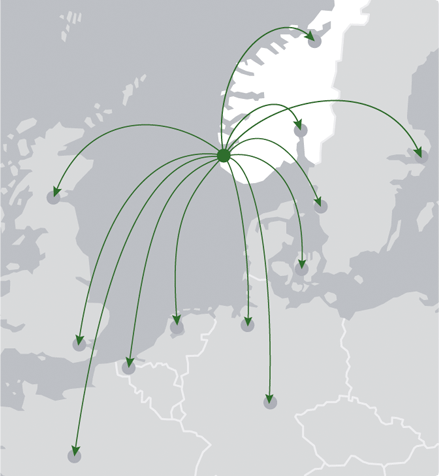
Communication
- redundancy
High capacity and redundancy
Local broad band operators
Good connectivity to the world
Multiple high capacity lines to Oslo
Multiple high capacity lines directly to the UK
Multiple high capacity lines to continental Europe
Carrier neutral availability
SubTech Data Center is a ground-level facility built inside solid limestone,
offering security unmatched by any other data center facility. SubTech is located in Kansas City, which provides one of the lowest utility costs in the country and is ranked #2 in the United States for enterprise data center operating affordability. SubTech's data center solutions are reliable and flexible, offering maximum power and connectivity for your robust data center needs. Site plans by
http://www.totalsitesolutions.com/
Expanding or needing data center space? SubTech has millions of square feet available for IT and raised floor area. The facility provides clients with data center space ranging from 5,000 - 100,000+ square feet with 16' clear ceiling heights throughout. The initial 100,000 s.f. can be built out in 20,000 s.f. modules. Click here to download our site plan. http://www.subtechkc.com/site_plan.pdf
Ora Reynolds (left), president of Hunt Midwest Real Estate Development, and Tammy Henderson, director of real estate marketing and governmental affairs, are preparing for when a portal (background) will be the front door to an underground data center.
The Kansas City-based company plans to build a 40,000-square-foot data center in Hunt Midwest SubTropolis. The massive underground business complex is roughly northeast of Interstate 435 and Missouri Highway 210 in Kansas City. Construction on the estimated $30 million SubTech project will begin once Hunt Midwest signs a tenant or tenants for the first 20,000 square feet, company President Ora Reynolds said. Reynolds said the company originally planned a 100,000-square-foot project but scaled back after an unsuccessful attempt in the summer to add state tax incentives for data centers to a bill aimed at retaining automotive jobs. Missouri is at a disadvantage, she said, because Kansas, Nebraska, Iowa and Oklahoma offer financial breaks for data centers. “The investment in a data center is so much more expensive than a regular building,” Reynolds said. “The investment is so large you can’t do ‘If you build it, they will come’ if you don’t think you can compete.” Reynolds said the company envisions a Tier 3 facility, meaning it has redundant power and cooling systems, with the ability to expand in 20,000-square-foot increments. “The thing that we’re saying is the biggest advantage, and what makes us different, is we have 8 million square feet that has been mined out and has not been developed at the present time,” Reynolds said. “Somebody who’s out there and says, ‘I need 20,000 square feet now, but I know I’m going to grow and need 100,000 square feet in the next five years,’ we can accommodate them while somebody who has an office building wouldn’t let half the building stay empty.” She said Hunt Midwest would be strictly a landlord, preferring to find a managed services/collocation firm to become the main tenant, subleasing rack and cabinet space to smaller companies or leasing entire data suites or powered shells — where the tenants install most of the technical infrastructure themselves. The data center business has taken off in recent years as companies have looked for options to remotely operate or back up data networks. New York-based Tier 1 Research said in a Sept. 23 report that demand has outstripped supply in many markets because the economy has slowed construction and financing of new data centers. The underground data center is relatively new in the industry, despite the obvious increase in security and resistance to natural disasters. Tier 1 analysts Jason Schafer and Michael Levy said in a separate report looking at the SubTech project that so-called data bunkers have had trouble attracting tenants in other markets because of the added complexity of supplying power and getting rid of excess heat and moisture. They said that SubTech does have size and the ability to grow in phases going for it but that it will run into the same skepticism other operators encounter. “This isn’t to say that there isn’t a market for a secure underground data center facility,” they wrote. “It just fits the needs of fewer types of tenants that are likely comparing all data center providers.” Cavern Technologies operates a 40,000-square-foot data center in the underground Meritex Lenexa Executive Park. Cavern President John Clune said the company has grown from four customers three years ago to 35. “Our market has really taken off,” he said, adding that not having to construct an actual building and underground’s cooler air temperatures let Cavern compete on cost. “The economics of the underground allow us to provide more space for the money.” Clune said that data centers typically charge as much as $1,200 a rack but that he charges $2,900 for 250 square feet — enough room for four racks. “It’s when people come down here that the light goes on,” he said. Numerous area companies operate their data centers, including some in underground space. Overland Park-based Sprint Nextel Corp. has three data centers supporting network operations, with two built into earthen embankments, spokeswoman Melinda Tiemeyer said. Other companies use underground caves to store computer data tapes.
What is SubTropolis?
SubTropolis was created through the mining of a 270-million-year-old limestone deposit. In the mining process, limestone is removed by the room and pillar method, leaving 25-foot square pillars that are on 65-foot centers and 40 feet apart.
The pillars’ even spacing, concrete flooring and 16-foot high, smooth ceilings make build-to-suit facilities time and cost efficient for tenants. A tenant requiring 10,000 to one million square feet can be in their space within 150 days. SubTropolis is completely dry, brightly lit, with miles of wide, paved streets accessed at street level.
Hunt Midwest SubTropolis sets the standard for subsurface business developments.
http://www.dataspecialtiesinc.com/index.html Phil Rafferty, President and Co-Founder, has more than 27 years of experience in the data center and cabling industries. Prior to co-founding DSI in 1990, he was the General Manager for a Los Angeles data center electrical contractor. In addition to running the company, Phil leads DSI’s key projects from design through completion. He also leads the company’s efforts to expand its geographic presence. Underground Data Center: design, construction, commissioning Data Specialties Inc. was founded in 1990 to serve the electrical and communications systems needs of U.S. corporations. We have stayed abreast of the dynamic technology, climate and security control, reliability assurances and political realities that our clients face—and have become a leader among data center design-build and cabling plan/install specialists. Today we manage all aspects of site selection, design, construction, commissioning and maintenance of mission-critical data centers. We also continuously anticipate future developments, ensuring that our designs deliver the reliability through redundancy that clients expect now and the scalability and flexibility to accommodate future moves, adds and changes.
Mike Manos discusses data center site selection, you need to “kick the dirt” to find what is real At Gartner’s Data Center Conference, Mike Manos made an excellent point that “75% of the data center costs are effected by site selection.” Great architecture is designed to a site characteristics. But, the status quo is to design data centers that are built based on past experiences. Green data centers need to be designed to fit with site characteristics.
Kickin’ Dirt by Mike Manos I recently got an interesting note from Joel Stone, the Global Operations Chief at Global Switch. As some of you might know Joel used to run North American Operations for me at Microsoft. I guess he was digging through some old pictures and found this old photo of our initial site selection trip to Quincy, Washington.
As you can see, the open expanse of farmland behind me, ultimately became Microsoft’s showcase facilities in the Northwest. In fact you can even see some farm equipment just behind me. It got me reminiscing about that time and how exciting and horrifying that experience can be.
Kicking the Dirt.
Many people I speak to at conferences generally think that the site selection process is largely academic. Find the right intersection of a few key criteria and locate areas on a map that seem to fit those requirements. In fact, the site selection strategy that we employed took many different factors into consideration each with its own weight leading ultimately to a ‘heat map’ in which to investigate possible locations.
Even with some of the brightest minds, and substantial research being done, its interesting to me that ultimately the process breaks down into something I call ‘Kickin Dirt’. Those ivory tower exercises ultimately help you narrow down your decisions to a few locations, but the true value of the process is when you get out to the location itself and ‘kick the dirt around’. You get a feel for the infrastructure, local culture, and those hard to quantify factors that no modeling software can tell you.
Mike makes an excellent point for the decision on site selection.
Once you have gone out and kicked the dirt, its decision time. The decision you make, backed by all the data and process in the world, backed by personal experience of the locations in question, ultimately nets out to someone making a decision. My experience is that this is something that rarely works well if left up to committee. At some point someone needs the courage and conviction, and in some cases outright insanity to make the call.
Are you willing to take a risk in site selection? Most aren’t. But, the leaders are, and they are the ones who are first to go where others haven’t and have lower costs. Mike has said the cost of the land was a great deal as no one thought of the land as a data center site. Google are the others who have this down.
Google and Yahoo as the industry leaders, as they have both "kicked the dirt" in far better places. Google has sited in Oregon (excellent tax incentives + cheap energy + green power), North Carolina (best of breed incentive package + reasonable power) and Finland (great existing asset + tax incentives + green power). Yahoo has built in Quincy (yes, they started first), Omaha (special tax incentives + cheap energy), Switzerland (green energy + tax holidays) and Buffalo (same).
Efforts to retrofit subterranean bunkers into functional data center space have been underway for years. But as power requirements and security considerations have intensified, organizations are not only taking up space in converted facilities, but selecting underground sites that are specifically designed from day one to house mission critical infrastructure.
Increased interest by organizations across a broad range of industries in ultra-secure underground data center space is being fueled by projected energy, security and regulatory benefits relative to aboveground alternatives. From reduced cooling expenditures to enhanced security from blast hardened, weatherproof design, site selection for Mission Critical Real Estate (MCRE) is trending towards subterranean facilities that can greatly reduce risk and vulnerability to unpredictable elements. While MCRE is an emerging acronym, it represents an established and growing category of real estate with stringent requirements that go beyond a traditional building space.
Examples of organizations turning their attention to subterranean MCRE abound:
• In early 2008, Wikia Search, a search engine brought to market by the founders of Wikipedia, launched via servers housed in the United States Secure Hosting Center (USSHC) ultra-secure underground hosting facility;
• This past fall Sun Microsystems announced a joint venture that will place self-contained computing facilities in a dormant Japanese coal mine;
• StrataSpace has built out a 500,000 square foot subterranean data center facility near Lousville, Kentucky;
• PHNS, a solutions provider serving hospitals and healthcare customers, developed a subterranean data center located 85 feet underground in a disaster-proof solid limestone cave near Springfield, Missouri; and
• Cavern Technologies has a 200,000 square foot underground facility just outside Kansas City.
This paper will highlight key benefits offered by underground facilities – particularly data center space specifically designed and constructed for mission critical infrastructure from day one. While organizations are motivated by myriad factors when it comes to data center site selection, this paper will focus on those that are consistently top of mind:
• Power and Cooling • Security • Green Standards • Protection from Natural Disasters
Power and Cooling
According to the Environmental Protection Agency (EPA) report released last year, energy usage at data centers doubled to roughly 60 billion kilowatt hours of electricity between 2000 and 2006. Moreover, the Uptime Institute estimates that a Tier IV facility requires $22,000 of power and cooling infrastructure for every kilowatt that gets used for processing.
While various energy efficiency strategies are being employed across the data center, power and cooling needs are still headed just one way – up. In citing key motivations behind its Japanese underground data center plans, Sun noted that the site temperature will be a constant 59 degrees Fahrenheit year round and ground water will be used for the coolant. Translation: no air-conditioning will be required outside of Sun’s data center containers, delivering electricity cost savings that the group estimates will save up to $9 million annually if 30,000 server cores were run.
Similarly, StrataSpace, which is building out a 500,000 square foot ultra-secure subterranean facility, can offer would-be tenants a consistent temperature averaging between 60-70 degrees year round. This spares facility managers from wild temperature swings that make it difficult to predict – and control – energy costs in an aboveground facility. StrataSpace estimates that total HVAC energy consumption can be reduced by 8.9% as compared to a standard above ground data center facility, delivering annual HVAC savings of roughly one-half million dollars.
Underground site selection is an increasingly appealing alternative for organizations that require a high number of cooling days because they are situated in geographically mild or warm areas of the country. In the case of StrataSpace for example, standard ambient air in Louisville has 1,443 cooling degree days (CDD ) in a season, compared to what StrataSpace estimates is 600 cooling degree days in their facility when fully occupied. The difference results in an estimated 28% reduction in peak hour cooling costs. And because underground ambient temperatures do not spike wildly, utility costs are reduced because HVAC equipment can operate at a lower temperature.
Security
Data center security is only as effective as the people who develop it and the processes and tools used to execute and enforce it. This holds true whether the facility is ten stories underground or in the top floors of a skyscraper.
That said, subterranean data center facilities enable organizations to reduce physical points of vulnerability and unauthorized access. With few doors or windows that can be left unguarded or inadvertently open, underground facilities allow organizations to focus energies – and budget resources – on a limited number of areas where personnel entry occurs. And because the facility can be located several stories underground and in nondescript locations, it is extremely difficult for individuals to find the location, or navigate to the entry point without an authorized escort.
AFCOM predicts that by 2010, more than half of all data centers — government and commercial alike — will have to relocate to larger, more secure facilities. The security attributes inherent to an underground facility can also aid organizations that house sensitive government information and want to establish compliance with TS/SCI (Top Secret/Sensitive Compartmented Information). SCIF covers stringent physical security requirements, such as the thickness of doors, the strength of concrete, and access to data – all areas where subterranean facilities compare favorably.
Green Standards
With the energy efficiency benefits laid bare, the challenge has not been getting data centers to “go green.” Instead, what organizations lack are universally recognized industry standards for the green data center. In fact, a recent Digital Realty Trust survey finds that 82 percent of companies said that no clear industry standard for green data centers existed.
As the industry seeks out clarity in outlining green benchmarks, many organizations are turning to available methods to track sustainability efforts. One such method is The Leadership in Energy and Environmental Design (“LEED”) building rating system, a nationally recognized benchmark for the design, construction, and operation of high performance “Green” buildings. LEED focuses performance on water efficiency, sustainable sites, energy and atmosphere, materials and resources, indoor environmental quality and innovation. Organizations can earn a maximum of 69 points for building design on the LEED checklist.
The Digital Realty Trust survey finds that the majority of companies view LEED standards as a model for their green data center initiatives; The Green Grid consortium was also mentioned as a credible resource in this area. With LEED top of mind for organizations, many are drawn to the ability of underground facilities to satisfy LEED certification points mentioned above. For example, the controlled temperature in a subterranean facility registers favorably in reducing cooling costs and air quality preservation.
Green data center standards will surely become increasingly codified over time. The EPA Energy Star Program ventured beyond its initial mandate to promote efficiency in the data center, and hopes to provide a method to rate data center energy efficiency by 2010. In the short term, subterranean site selection offers a way to satisfy both existing LEED certification priorities while also carving a path to meeting future green data center measurement standards.
Protection from Natural Disasters
Natural disasters and deliberate, more sinister threats to mission critical facilities remain top of mind when it comes to site selection. Each geographic region has its own risks, though when it comes to natural disasters that are weather related, aboveground facilities will always face a certain level of vulnerability.
Selecting a specifically designed subterranean space can eliminate or mitigate many of these natural disaster risks. Underground facilities are increasingly being built using blast-hardened limestone, creating an environment that is weather proof, protected from natural disasters and safeguarded from nearly any conventional weapon.
The site selection benefits of choosing this type of underground facility are not confined to protecting the space itself, but the equipment that resides inside. This is because all key infrastructure – including generators, fuel storage and chiller plants – is situated underground and out of danger from natural disasters and extreme elements. By eliminating exposure to outdoor elements, organizations can realize cost efficiency benefits by extending the lifespan of the building component that would typically occur due to wear and tear from aboveground elements.
Conclusion
With rapidly escalating power, space and security requirements, Mission Critical Real Estate (MCRE) site selection represents one of the most significant decisions an organization can make to ensure that current and future data needs are met. From real estate developers charged with finding cost effective, secure and scalable data center space for Fortune 1000 clients, to government organizations evaluating colocation facilities best suited to safeguard sensitive government information, subterranean facilities have emerged as an appealing alternative to aboveground alternatives.
About the Author: Lee Kirby is Vice President & General Manager with Lee Technologies Benjamin J. Pasley, Jr. is a Manager with Lee Technologies.
Technology based companies are building new data centers in old mines, caves, and bunkers to host computer equipment below the Earth's surface.
Underground Secure Data Center Operations have a upward trend.
Operations launched in inactive gypsum mines, caves, old abandoned coal mines, abandoned solid limestone mines, positioned deep below the bedrock mines, abandoned hydrogen bomb nuclear bunkers, bunkers deep underground and secure from disasters, both natural and man-made.
The facility have advantages over traditional data centers, such as increased security, lower cost, scalability and ideal environmental conditions. There economic model works, despite the proliferation of data center providers, thanks largely to the natural qualities inherent in the Underground Data Centers.
With 10,000, to to over a 1,000,000 square feet available, there is lots of space to be subdivided to accommodate the growth needs of clients. In addition, the Underground Data Centers has an unlimited supply of naturally cool, 50-degree air, providing the ideal temperature and humidity for computer equipment with minimal HVAC cost.
They are the most secure data centers in the world and unparalleled in terms of square footage, scalability and environmental control.
Yet, while the physical and cost benefits of being underground make them attractive, they have to also invested heavily in high-speed connectivity and redundant power and fiber systems to ensure there operations are not just secure, but also state-of-the-art.
There initially focused on providing disaster recovery solutions, and backup co-location services.
Clients lease space for their own servers, while other provides secure facilities, power and bandwidth. They offers redundant power sources and multiple high-speed Internet connections through OC connected to SONET ring linked to outside connectivity providers through redundant fiber cables.
Underground Data Centers company augments there core services to include disaster recovery solutions, call centers, NOC, wireless connectivity and more.
Strategic partnering with international, and national information technology company, enable them to offer technology solutions ranging from system design and implementation to the sale of software and equipment.
The natural qualities of the Underground Data Centers allow them to offer the best of both worlds premier services and security at highly competitive rates.
Underground Data Centers were established starting in 1990's but really came into there own after September 11 attacks in 2001 when there founders realized the former mines, and bunker offered optimal conditions for a data center. The mines, and bunkers offered superior environmental conditions for electronic equipment, almost invulnerable security and they located near power grids.
Adam Couture, a Mass.-based analyst for Gartner Inc. said Underground Data Centers could find a niche serving businesses that want to reduce vulnerability to any future attacks. Some Underground Data Centers fact sheet said that the Underground Data Center would protect the data center from a cruise missile explosion or plane crash.
Every company after September 11 attacks in 2001 are all going back and re-evaluating their business-continuity plans, This doesn't say everybody's changing them, but everybody's going back and revisiting them in the wake of what happened and the Underground Data Center may be just that.
Comparison chart: Underground data centers
Five facilities compared
Robert L. Mitchell
Name
InfoBunker, LLC
The Bunker
Montgomery Westland
Cavern Technologies
Iron Mountain The Underground
Location
Des Moines, Iowa*
Dover, UK
Montgomery, Tex.
Lenexa, Kan.
Butler County, Penn.*
In business since
2006
1999
2007
2007
Opened by National Storage in 1954. Acquired by Iron Mountain 1998.
Security /access control
Biometric; keypad; pan, tilt and zoom cameras; door event and camera logging
CCTV, dogs, guards, fence
Gated, with access control card, biometrics and a 24x7 security guard
24-hour armed guards, visitor escorts, magnetometer, x-ray scanner, closed-circuit television, badge access and other physical and electronic measures for securing the mine's perimeter and vaults
Distance underground (feet)
50
100
60
125
220
Ceiling height in data center space (feet)
16
12 to 50
10
16 to 18
15 (10 feet from raised floor to dropped ceiling)
Original use
Military communications bunker
Royal Air Force military bunker
Private bunker designed to survive a nuclear attack. Complex built in 1982 by Louis Kung (Nephew of Madam Chang Kai Shek) as a residence and headquarters for his oil company, including a secret, 40,000 square foot nuclear fallout shelter. The office building uses bulletproof glass on the first floor and reception area and 3-inch concrete walls with fold-down steel gun ports to protect the bunker 60 feet below.
Limestone mine originally developed by an asphalt company that used the materials in road pavement
Limestone mine
Total data center space (square feet)
34,000
50,000
28,000 plus 90,000 of office space in a hardened, above-ground building.
40,000
60,000
Total space in facility
65,000
60,000
28,000
3 million
145 acres developed; 1,000 acres total
Data center clients include
Insurance company, telephone company, teaching hospital, financial services, e-commerce, security monitoring/surveillance, veterinary, county government
Banking, mission critical Web applications, online trading
The Editor:
My Name is Gary E.Weller; this is what I am thinking about in the time and space when I am writing this newsletter, you will never know what to expect from my mind or others. When I let my hair grow long some folk say I look like Albert Einstein what a compliment, I will try to keep my hair as long as I can. I prefer to Die on my feet than Live on my knees!"
ACAE - Air conditioning airflow efficiency, the amount of heat removed per standard cubic foot of airflow per minute
AHU - Air handling unit
Air Mixing - The unintended mixing of cold and hot air
Airside Economizer - An economizer that directs exterior air into the data center when the air temperature is at or below the cooling set point
Aisle - The open space between rows of racks. Best-practice dictates racks should be arranged with consistent orientation of front and back to create ‘cold'and ‘hot'aisles.
AMS - Asset management system
ASHRAE - American Society of Heating, Refrigerating and Air-Conditioning Engineers is an international technical society organized to advance the arts and sciences of air management.
BACnet - A data communication protocol for building automation and control networks BAS - Building automation system Blanking Panel - A device mounted in unused U spaces in a rack that restricts bypass airflow, also called blanking or filler plates BMS - Building management system, synonymous with BAS, AMS and other computer-based tools used to manage data center assets BTU - British thermal until, a standard measure of cooling equipment capacity Bypass Airflow - Conditioned air that does not reach computer equipment, escaping through cable cut-outs, holes under cabinets, misplaced perforated tiles or holes in the computer room perimeter walls. C - Degrees Celsius
C/H - Cooling/Heating Cabinet - Device for holding IT equipment, also called a rack CAC - Cold aisle containment system that directs cooled air from air conditioning equipment to the inlet side of racks in a highly efficient manner CADE - Corporate average data center efficiency CapEx - Capital expense, the cost of purchasing capital equipment Carbon Footprint - A measurement of the volume in pounds of Carbon Dioxide generated by business operations. CFD - Computational fluid dynamics, scientific calculations applied to airflow analysis CFM - Cubic feet per minute, an airflow volume measurement Close-Coupled Cooling - Cooling technology that is installed adjacent to server racks and enclosed to direct airflow directly to the rack without mixing with DC air Coefficient of Effectiveness (CoE) - Uptime Institute metric based on the Nash-Sutcliffe model efficiency coefficient Cold Aisle - An aisle where rack fronts face into the aisle. Chilled airflow is directed into this aisle so that it can then enter the fronts of the racks in a highly efficient manner. Cold Spot - An area where ambient air temperature is below acceptable levels. Typically caused by cooling equipment capacity exceeding heat generation. CR - Computer room CRAC - Computer room air conditioner (pronounced crack) that uses a compressor to mechanically cool air CRAH - Computer room air handler (pronounced craah) that uses chilled water to cool air Critical Load - Computer equipment load delivered by PDU output CSI - Cold supply infiltration index, quantifies the amount of hot air mixing with cold inlet air prior to entering the rack. Cutout - An open area in a raised floor that allows airflow or cable feeds CW - Chilled water DC - Data center DCiE - Data center infrastructure efficiency is an efficiency measure that is calculated by dividing the IT equipment power consumption by the power consumption of the entire data center. This measure is the inverse of PUE. Dead Band - An HVAC energy saving technique whereby sensitivity set points of equipment are set more broadly to improve coordination of the equipment and avoid offsetting behaviors, also dead band control strategy Delta T - Delta temperature, the spread between the inlet and outlet air temperatures of air conditioning equipment, measured as the maximum achievable difference between inlet (return) and outlet (supply) temperatures. This is not the astronomical measurement of Terrestrial Dynamical Time minus Universal Time. Dewpoint - The temperature at which air reaches water vapor saturation, typically used when examining environmental conditions to ensure they support optimum hardware reliability D/H - Dehumidifying/Humidifying Dry-Bulb Temperature - The temperature of the air measured using a dry-bulb thermometer, typically taken in conjunction with a wet-bulb reading in order to determine relative humidity EFC - Equivalent full cabinets, the number of full cabinets that would exist if all the equipment in the data center were concentrated in full cabinets ESD - Electrostatic discharge, more commonly ‘static discharge' F - Degrees Fahrenheit Ft2 - Square feet or foot GPM - Gallons per minute HAC - Hot aisle containment system that directs heated air from the outlet side of racks to air conditioning equipment return ducts in a highly efficient manner Harmonic Distortion - Multiples of power frequency superimposed on the power waveform that causes excess heating in wiring and fuses Heat Exchanger - A device used to transfer heat energy, typically used for removing heat from a chilled liquid system HDG - Hot dipped galvanized Hot Aisle - An aisle where rack backs face into the aisle. Heated exhaust air from the equipment in the racks enters this aisle and is then directed to the CRAC return vents. HPDC - High-performance data center, a data center with above average kW loading, typically greater than 10kW/rack Hot Spot - An area, typically related to a rack or set of racks, where ambient air temperature is above acceptable levels. Typically caused by heat generation in excess of cooling equipment capacity. Hp - Horsepower Hr - Hour HVAC - Heating, ventilation and air conditioning system, the set of components used to condition interior air including heating and cooling equipment as well as ducting and related airflow devices In-Row Cooling - Cooling technology installed between server racks in a row that delivers cooled air to equipment more efficiently Inlet Air - The air entering the referenced equipment. For air conditioning equipment this is the heated air returning to be cooled, also called return air. For racks and servers this is the cooled air entering the equipment. IP - Internet protocol, a communications technology using the internet for communications. IR - Infrared spectrum used by thermal imaging technologies JVM - Java virtual machine, Java interpreter. Software that converts the Java intermediate language into executable machine language. kBTU - Kilo British thermal unit, one thousand BTU, a unit of measurement for the cooling capacity of a CRAH kCFM - Kilo-cubic feet per minute, 1000 CFM kV - Kilovolt kW - Kilowatts kWc - Kilowatts of cooling, alternate unit of measurement for the cooling capacity of a CRAH kWh - Kilowatt hours kVA - Kilovolt amperes = voltage x current (amperage) KVM - Keyboard, video, mouse; an interface technology that enables users to access multiple servers remotely from one or more KVM sites. More obscurely, can also mean K Virtual Machine: a version of the Java Virtual Machine for small devices with limited memory. Latent Cooling Capacity - Cooling capacity related to wet bulb temperature and objects that produce condensation Line Noise - Distortions superimposed on the power waveform that causes electromagnetic interference Liquid Cooling - A general term used to refer to cooling technology that uses a liquid circulation system to evacuate heat as opposed to a condenser, most commonly used in reference to specific types of in-row or close-coupled cooling technologies Load - The kW consumption of equipment, typically installed in a rack. Also, the heat level a cooling system is required to remove from the data center environment MAH - Makeup air handler, a larger air handler that conditions 100% outside air. Synonymous with MAU. Make-Up Air - The conditioned air delivered by a MAU or MAH MAU - Makeup air unit, a larger air handler that conditions 100% outside air. Synonymous with MAH. Maximum Temperature Rate of Change - An ASHRAE standard established to ensure stable air temperatures. The standard is 9 degrees F per hour. MERV - Minimum efficiency reporting value , ASHRAE 52.2, for air filtration measured in particulate size. N+1 - Need plus one, a redundancy concept where capacity is configured to include planned capacity plus one additional device to enable continued operations with the failure of one system in the configuration. This presumes immediate detection and remediation of the failed unit. NEBS - Network equipment-building system design guidelines applied to telecommunications equipment No. - Number Nominal Cooling Capacity - The total cooling capacity of air conditioning equipment, includes both latent and sensible capacities. Due to humidity control in data centers, the latent capacity should be deducted from nominal capacity to determine useful capacity OpEx - Operating expense, the ongoing expenses related to operating the data center Overcooling - A situation where air is cooled below optimum levels. Typically used in reference to rack inlet temperatures. PDU - Power distribution unit Pole - A row of power receptacles with power supplied from a PDU Pole Position - A power receptacle on a pole Pressure Differential - The difference in pressure between two locations in the data center used to analyze air flow behaviors PH - Phase, electrical phase 1-3 Plenum - A receiving chamber for air used to direct air flow PU - Packaged unit, an air handler designed for outdoor use. PUE - Power usage effectiveness, a measure of data center energy efficiency calculated by dividing the total data center energy consumption by the energy consumption of the IT computing equipment. This measure is the inverse of DCiE. Rack - Device for holding IT equipment, also called a cabinet RAH - Recirculation air handler, a device that circulates air but does not cool the air Raised Floor - Metal flooring on stanchions that creates a plenum for airflow and cabling, synonymous with RMF Recirculation - Chilled airflow returning to cooling units without passing through IT equipment, also referred to as short cycling Return Air - The heated air returning to air conditioning equipment RFI - Radio frequency interference Rh - Relative humidity RMF - Raised metal floor, an alternate term for the more commonly used term ‘raised floor' ROI - Return on investment, a measure of the amount of time required to recover an investment RPM - Revolutions per minute, used to measure fan speeds RPP - Remote power panel RTU - Rooftop unit, an air handler designed for outdoor use mounted on a rooftop. A typical application of a PU. S+S - System plus system SCFM - Standard cubic feet per minute, the volumetric flow rate of a gas corrected to standardized conditions of temperature, pressure and relative humidity Sensible Cooling Capacity - Cooling capacity related to dry bulb temperature and objects that do not produce condensation Sensitivity - An equipment setting that bounds the set point range and triggers a change in device function when exceeded. Most commonly referring to CRAC/CRAH temperature and humidity set points. Set Point - Typically used in reference to air conditioning equipment thermostat temperature and humidity settings Short Cycling - Chilled airflow returning to cooling units without passing through IT equipment, also referred to as recirculation STS - Static transfer switch Sub-Floor - The open area underneath a raised computer floor, also called a sub-floor plenum Supply Air - The cooled airflow emitted from air conditioning equipment TCE - Triton Coefficient of EffectivenessSM, synonymous with UCE Thermistor - A type of resistor with resistance varying according to its temperature U - Rack mount unit, the standardized height of one unit is 1.75" UCE - Upsite Coefficient of EffectivenessSM, synonymous with TCE UPS - Uninterruptible power supply, device used to supply short-term power to computing equipment for brief outages or until an alternate power source, such as a generator, can begin supplying power. VFD - Variable frequency drive W - Watt(s) Waterside Economizer - An economizer that redirects water flow to an external heat exchanger when the exterior ambient air temperature is at or below a temperature required to chill water to a given set point, simultaneously shutting down the mechanical chiller equipment. Wet-Bulb Temperature - The temperature of the air measured using a wet-bulb thermometer, typically taken in conjunction with a dry-bulb reading in order to determine relative humidity Wg - Inches of water column, an approximate unit of measurement for static air pressure Work Cell - The area of a rack and the related area immediately in front of and behind the rack. Standard racks are 2 feet wide and 4 feet deep. Standard aisles are 4 feet wide, so half of that space is workspace for a given rack. This results in a standard work cell of 16 square feet. Actual work cell size varies with data center design. WPSF - Watts per square foot




 The Mountain Hall

 Fire safety and fire
 Safe as a vault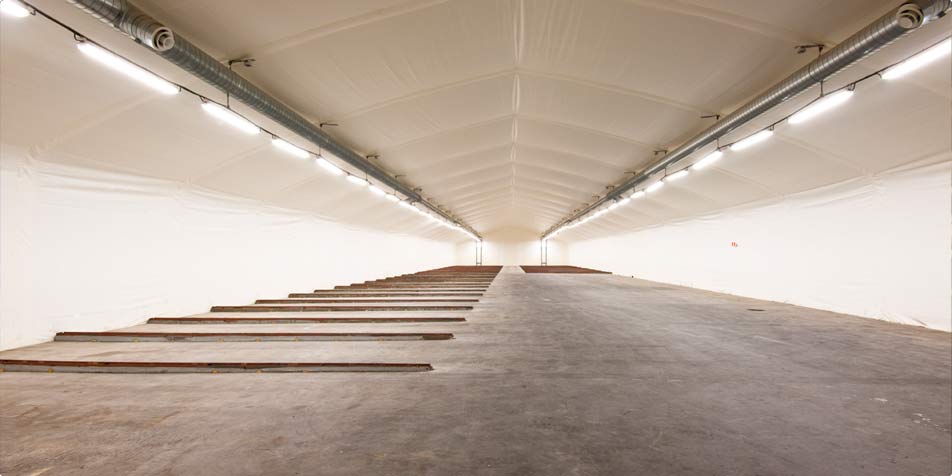

 Communication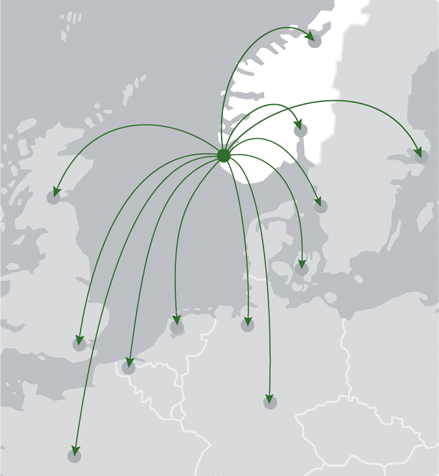


 SubTech Data Center is a ground-level facility built inside solid limestone,


 Phil Rafferty, President and Co-Founder, has more than 27 years of experience in the data center and cabling industries. Prior to co-founding DSI in 1990, he was the General Manager for a Los Angeles data center electrical contractor. In addition to running the company, Phil leads DSI’s key projects from design through completion. He also leads the company’s efforts to expand its geographic presence.
 Data Specialties Inc. was founded in 1990 to serve the electrical and communications systems needs of U.S. corporations. We have stayed abreast of the dynamic technology, climate and security control, reliability assurances and political realities that our clients face—and have become a leader among data center design-build and cabling plan/install specialists. Today we manage all aspects of site selection, design, construction, commissioning and maintenance of mission-critical data centers. We also continuously anticipate future developments, ensuring that our designs deliver the reliability through redundancy that clients expect now and the scalability and flexibility to accommodate future moves, adds and changes.


Google and Yahoo as the industry leaders, as they have both "kicked the dirt" in far better places. Google has sited in Oregon (excellent tax incentives + cheap energy + green power), North Carolina (best of breed incentive package + reasonable power) and Finland (great existing asset + tax incentives + green power). Yahoo has built in Quincy (yes, they started first), Omaha (special tax incentives + cheap energy), Switzerland (green energy + tax holidays) and Buffalo (same).